
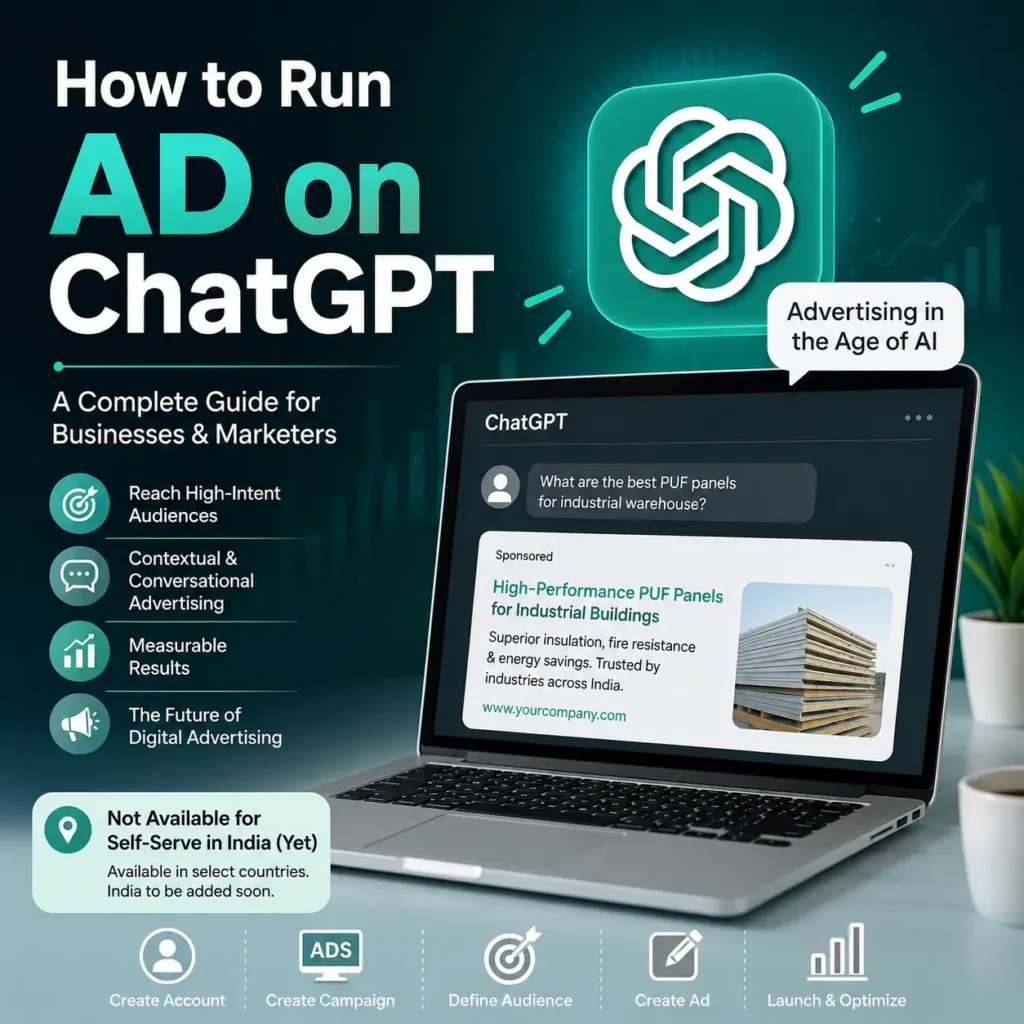
Artificial intelligence is changing the way people search, research products, compare services, and make buying decisions.
For years, businesses focused on platforms such as Google Ads, Meta Ads, LinkedIn Ads, and YouTube Ads. Now, a new advertising opportunity is emerging: advertising inside ChatGPT.
OpenAI has started testing and expanding ChatGPT Ads, allowing businesses to reach people while they are exploring options, comparing products, researching services, and making decisions through conversations.
But there is an important point for Indian businesses and digital marketers:
As of August 2026, ChatGPT Ads are not yet available for self-serve advertising in India.
OpenAI currently supports advertising in selected markets, including the United States, United Kingdom, Mexico, Brazil, Japan, South Korea, Canada, Australia, and New Zealand as the program continues to expand. India is not currently included in the supported self-serve markets.
So, how does ChatGPT advertising work, and what should Indian businesses prepare for?
Let’s understand it step by step.
What Are ChatGPT Ads?
ChatGPT Ads are paid advertisements that can appear within the ChatGPT experience.
Unlike traditional search advertising, where an advertiser primarily targets keywords such as “best digital marketing agency in Bangalore,” ChatGPT advertising is designed around conversational intent and context.
Are ChatGPT Ads Available in India?
Not yet for self-serve advertising.
This is one of the most important points Indian marketers should understand.
OpenAI has been gradually expanding ChatGPT Ads into different countries. The latest OpenAI update dated August 11, 2026, confirms launches in the UK, Mexico, Brazil, Japan, and South Korea, following earlier expansion into other markets.
India is currently not included in the supported Ads Manager markets.
If your business is based in India, you can currently register your interest with OpenAI and wait for availability to expand to India.
This means Indian advertisers should not confuse having access to ChatGPT with having access to ChatGPT Ads.
You can use ChatGPT in India, but that does not automatically mean you can create an advertising campaign.
How to Create a ChatGPT Account
Before understanding advertising, let’s look at how someone can create a normal ChatGPT account.
Step 1: Visit ChatGPT
Go to ChatGPT through the official website:
You can also use the official ChatGPT applications on Android and iOS.
Step 2: Sign Up
Choose the Sign Up option.
Depending on the available options, you can register using an email address or an available sign-in method such as Google, Apple, or Microsoft.
Step 3: Complete Your Account
Follow the verification and account setup process.
Once completed, you can start using ChatGPT.
Importantly, a normal ChatGPT account is different from an OpenAI Ads Manager account.
Your ChatGPT login allows you to use ChatGPT. An Ads Manager account is used by businesses to create and manage advertising campaigns.
What Can You Do With ChatGPT?
Even without advertising, ChatGPT provides businesses and marketers with a wide range of capabilities.
Depending on the plan and current availability, users can use ChatGPT for:
- Content writing
- Brainstorming
- Research
- Data analysis
- Coding
- Image creation
- File and document analysis
- Web search
- Business planning
- Marketing strategy
- Content optimization
- Summarizing information
- Creating marketing concepts
- Analyzing spreadsheets and data
OpenAI’s current Free plan also provides access to web search, image/file uploads, image generation, data analysis, and GPTs, subject to usage limits and feature availability.
Paid plans generally provide higher usage limits and additional capabilities.
For example, ChatGPT Go provides expanded access to tools, image generation, file uploads, advanced data analysis, longer memory, projects, tasks, custom GPTs, and Library features, subject to availability and limits.
How Does ChatGPT Advertising Work?
Once a business is in a supported market, advertising is managed through OpenAI Ads Manager.
The basic process is:
1. Create an Ads Manager Account
Advertisers sign up for access to OpenAI’s advertising platform.
After registration, advertisers can access Ads Manager to create campaigns, ad groups, advertisements, and manage performance.
2. Create a Campaign
A campaign defines the overall marketing goal and budget.
Current campaign objectives include:
- CPM – Cost per 1,000 impressions
- CPC – Cost per click
- oCPC – Conversion-optimized cost per click
Campaigns can include objectives, budgets, conversion events, dates, countries, platforms, and audience settings.
3. Create Ad Groups
Ad groups help organize advertisements around a particular product, service, audience, or use case.
This is where marketers need to think differently from traditional keyword advertising.
Instead of creating hundreds of ads around individual keywords, the focus should be on when your product or service is genuinely useful to a user.
4. Create Your Ads
ChatGPT Ads can contain elements such as:
- Advertiser name
- Logo/favicon
- Headline
- Description
- Image
- Landing page
Ads appear separately from ChatGPT’s answers and are clearly identified as sponsored content.
5. Add a Relevant Landing Page
Your advertisement should take users to a highly relevant landing page.
For example:
Ad: Industrial PUF Sandwich Panels
Landing page: PUF Sandwich Panel product page
Instead of:
Ad: Industrial PUF Sandwich Panels
Landing page: Generic homepage
OpenAI recommends using relevant product pages, collection pages, or content pages and maintaining a clear connection between the advertisement and landing page.
6. Launch and Optimize
After the campaign is approved and active, advertisers can monitor performance, make changes, and optimize their campaigns.
OpenAI’s Ads Manager provides reporting around metrics such as impressions, clicks, and conversions.
How Is ChatGPT Ads Different From Google Ads?
This is where things become particularly interesting for digital marketers.
Google Ads is heavily associated with search queries and keywords.
For example:
Keyword:
“Mangalore airport taxi”
A Google advertiser can bid for that keyword.
ChatGPT advertising operates differently.
A user might have a much longer conversation:
“I’m travelling to Mangalore next week with my family. I need airport pickup, sightseeing, and transportation for three days.”
The conversation contains much richer context than a simple keyword.
This creates the possibility of advertising around intent rather than just keywords.
That doesn’t mean keywords become irrelevant. Instead, marketers need to understand the broader context in which their product or service can be useful.
What Kind of Businesses Could Benefit?
The potential applications are enormous.
Travel & Tourism
A user planning a holiday could potentially encounter relevant advertisements from:
- Hotels
- Taxi services
- Travel agencies
- Tour operators
- Airlines
- Activity providers
E-commerce
Users comparing products could potentially see relevant advertisements from:
- Electronics brands
- Furniture companies
- Fashion brands
- Home improvement businesses
- Consumer product companies
B2B
ChatGPT could become particularly interesting for B2B marketing.
Someone researching:
“What is the best insulation solution for a cold storage warehouse?”
could potentially be exposed to relevant advertising from manufacturers or suppliers.
Professional Services
Businesses offering:
- Digital marketing
- Software
- Accounting
- Consulting
- Recruitment
- Legal services
- Education
could potentially benefit from reaching users during research and consideration stages.
What Makes a Good ChatGPT Ad?
OpenAI recommends focusing on clear, specific and benefit-focused advertising.
Instead of writing:
“We Are The Best Company. Contact Us Today!”
A stronger approach would be:
“Reduce Warehouse Heat Gain With High-Insulation PUF Panels”
The second message immediately communicates:
- What the product is
- Who it is for
- What benefit it provides
OpenAI also recommends creating multiple distinct ad variations so the system can identify more opportunities where different messages may be relevant.
Does ChatGPT Advertising Change ChatGPT’s Answers?
This is another important distinction.
No.
OpenAI states that advertisements are separate from ChatGPT’s answers. Advertisers cannot pay to influence, rank, or alter the answers generated by the model.
Ads are clearly labeled and displayed separately from the response.
This separation is important because users need to distinguish between an AI-generated answer and paid advertising.
What Should Indian Marketers Do Right Now?
Even though ChatGPT Ads aren’t currently available for self-serve advertising in India, Indian businesses shouldn’t ignore the development.
This is the perfect time to prepare.
1. Build Strong Brand Visibility
Make sure your brand has a clear digital footprint across your website, social profiles, business listings, publications, and other relevant sources.
2. Create Useful Content
Don’t create content only for keywords.
Create content that genuinely answers customer questions.
For example:
Instead of only targeting:
“PUF Panel Manufacturer in India”
create useful content around:
- How to select PUF panels
- PUF vs PIR panels
- PUF panels for cold storage
- PUF panel thickness guide
- Warehouse insulation solutions
- PUF panel installation considerations
3. Improve Your Website
Your website should clearly communicate:
- What you sell
- Who you serve
- Where you operate
- Your products/services
- Benefits
- Pricing information where appropriate
- Contact information
- Trust signals
- Case studies
- FAQs
4. Think Beyond SEO
Search optimization is evolving.
Businesses now need to think about:
SEO → AI Search → AI Visibility → AI Advertising
The companies that start understanding conversational search behaviour today may have an advantage when AI advertising becomes more widely available.
Final Thoughts
ChatGPT Ads represent a significant change in digital advertising.
Google Ads introduced the ability to advertise around search intent.
Social media advertising introduced advertising based heavily on audience characteristics and interests.
ChatGPT Ads introduce another possibility:
Advertising around conversational context and decision-making.
For Indian businesses, the opportunity is not available for self-serve advertising yet.
But that doesn’t mean marketers should wait.
Start building your brand’s authority, improve your website, create genuinely useful content, understand customer questions, and develop a strong digital presence.
When ChatGPT Ads eventually expand into India, businesses that have already built strong foundations will be better positioned to take advantage of the platform.
The future of advertising may not be just about what people search for. It may also be about what they are trying to accomplish.