
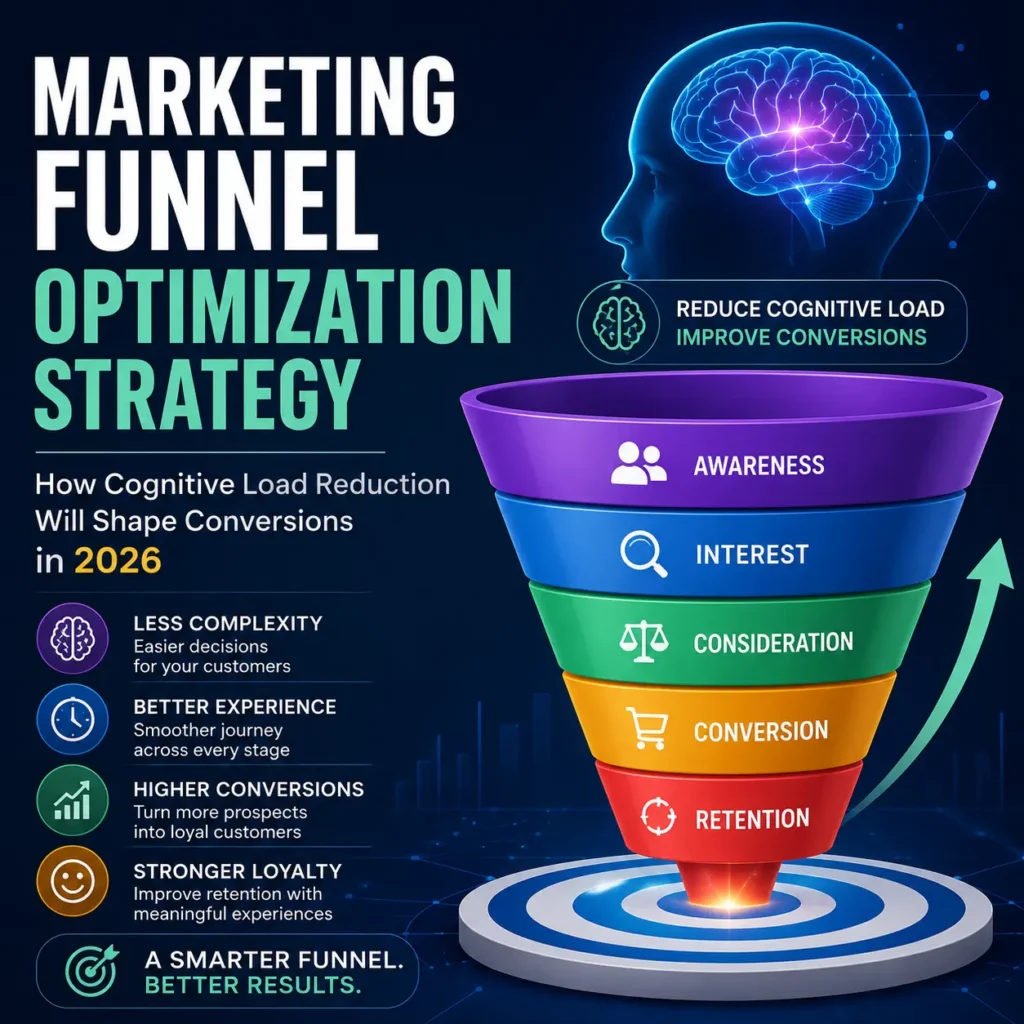
In the rapidly evolving digital landscape, businesses are constantly searching for innovative ways to improve customer experiences and increase conversions. As we move into 2026, one of the most influential trends shaping digital marketing is cognitive load reduction. Combined with an effective Marketing Funnel Optimization Strategy, this approach helps businesses simplify customer journeys, minimize decision fatigue, and encourage faster purchasing decisions.
Understanding how customers process information is becoming just as important as understanding what products or services they need. By reducing the mental effort required to navigate a website, understand an offer, or complete a purchase, businesses can significantly improve engagement and conversion rates.
What Is a Marketing Funnel Optimization Strategy?
A Marketing Funnel Optimization Strategy is the process of improving every stage of the customer journey—from awareness and consideration to conversion and retention. The goal is to guide prospects smoothly through the funnel while removing obstacles that may prevent them from taking action.
An optimized marketing funnel focuses on:
- Improving user experience
- Increasing engagement rates
- Reducing bounce rates
- Enhancing lead generation
- Boosting conversion rates
- Strengthening customer retention
Traditionally, businesses optimized funnels through A/B testing, content improvements, and conversion rate optimization. However, the growing influence of neuro-marketing is introducing a new layer of optimization focused on human psychology and cognitive behavior.
Understanding Cognitive Load in Marketing
Cognitive load refers to the amount of mental effort required for a person to process information and make decisions. When users encounter excessive information, confusing navigation, or multiple choices, they experience cognitive overload.
Examples of high cognitive load include:
- Cluttered website layouts
- Complex checkout processes
- Lengthy forms
- Too many product options
- Unclear calls-to-action
- Information-heavy landing pages
When cognitive load increases, users often abandon websites, delay decisions, or leave without converting.
A successful Marketing Funnel Optimization Strategy in 2026 will prioritize reducing cognitive load to create a more intuitive and frictionless customer experience.
Why Cognitive Load Reduction Matters in 2026
Consumer attention spans continue to decrease while digital competition continues to grow. Users expect quick answers, seamless navigation, and effortless interactions across all devices.
Several emerging trends are driving the importance of cognitive load reduction:
Increased Information Saturation
Consumers are exposed to thousands of marketing messages every day. Simplified communication helps brands stand out and improve message retention.
Rise of Mobile-First Experiences
Mobile users demand streamlined experiences. Complex interfaces that work on desktops may frustrate mobile visitors and reduce conversion opportunities.
AI-Powered Personalization
Artificial intelligence allows marketers to deliver highly relevant content, reducing the amount of information customers must process before making decisions.
Neuro-Marketing Advancements
Businesses are increasingly leveraging neuroscience insights to understand how customers think, evaluate options, and respond to marketing messages.
These factors make cognitive load reduction a critical component of every modern Marketing Funnel Optimization Strategy.
Key Ways to Reduce Cognitive Load in Marketing Funnels
Simplify Website Navigation
Users should get the requirement what they need within seconds. Clear menus, intuitive layouts, and logical page structures help reduce confusion.
Best practices include:
- Limiting menu options
- Using clear navigation labels
- Organizing content logically
- Implementing effective search functionality
The easier it is for users to navigate, the more likely they are to continue through the funnel.
Minimize Form Fields
Long forms often discourage conversions. Collect only essential information during the initial interaction.
For example, asking for a name and email address may be sufficient for lead generation. Additional information can be gathered later through nurturing campaigns.
Use Clear Calls-to-Action
Customers should never wonder what action to take next.
Effective CTAs include:
- Get Started
- Request a Free Quote
- Download the Guide
- Book a Consultation
- Contact Us Today
A focused CTA helps users move through the funnel without hesitation.
Reduce Choice Overload
While offering multiple options can be beneficial, too many choices often lead to decision paralysis.
Businesses can simplify decision-making by:
- Highlighting recommended options
- Grouping products into categories
- Using comparison tables
- Providing personalized recommendations
This approach helps customers make confident purchasing decisions.
Improve Content Readability
Dense blocks of text increase cognitive effort.
Instead, use:
- Short paragraphs
- Bullet points
- Headings and subheadings
- Visual elements
- Infographics
Easy-to-scan content improves engagement and keeps users moving through the funnel.
The Role of Neuro-Marketing in Funnel Optimization
Neuro-marketing combines marketing principles with insights from psychology and neuroscience. It helps the management to understand how consumers process information and make decisions.
A data-driven Marketing Funnel Optimization Strategy can use neuro-marketing techniques such as:
Social Proof
Customer reviews, testimonials, and case studies build trust and reduce uncertainty.
Visual Hierarchy
Strategically placing important information directs user attention toward conversion-focused elements.
Emotional Triggers
Many purchasing decisions are influenced by emotions first, while logical reasoning often serves to validate the final choice. Storytelling and emotional messaging can increase engagement and conversions.
Anchoring
Displaying premium options alongside standard packages can influence purchasing decisions and perceived value.
These techniques help businesses reduce mental effort while increasing customer confidence.
Measuring the Success of Your Marketing Funnel Optimization Strategy
To determine whether your funnel optimization efforts are successful, monitor key performance indicators such as:
Conversion Rate
Tracks the number of users who progress from interest to action within your marketing funnel.
Bounce Rate
A lower bounce rate often indicates improved user experience and reduced cognitive friction.
Time on Page
Engaged visitors typically spend more time consuming content and exploring solutions.
Cart Abandonment Rate
Reducing checkout complexity can significantly lower abandonment rates.
Lead Generation Metrics
Track form submissions, consultation requests, and email signups to evaluate funnel performance.
Regular analysis allows businesses to identify bottlenecks and continuously improve customer journeys.
Future-Proofing Your Marketing Funnel for 2026 and Beyond
The future of digital marketing will increasingly focus on simplicity, personalization, and customer-centric experiences. Businesses that embrace cognitive load reduction will gain a competitive advantage by making it easier for customers to engage, evaluate, and purchase.
To stay ahead:
- Prioritize user experience design
- Leverage AI-powered personalization
- Simplify decision-making processes
- Use neuro-marketing insights
- Continuously test and optimize funnel elements
A modern Marketing Funnel Optimization Strategy is no longer just about driving traffic—it is about creating effortless experiences that guide users naturally toward conversion.
Conclusion
As neuro-marketing continues to influence digital marketing trends in 2026, cognitive load reduction will become a defining factor in conversion optimization. Customers increasingly prefer simple, intuitive, and personalized experiences that help them make decisions quickly and confidently.
By implementing a comprehensive Marketing Funnel Optimization Strategy focused on reducing cognitive load, businesses can improve engagement, enhance user satisfaction, and achieve higher conversion rates. Organizations that embrace this approach today will be better positioned to thrive in the increasingly competitive digital marketplace of tomorrow.